

Hi, I’m Toya!
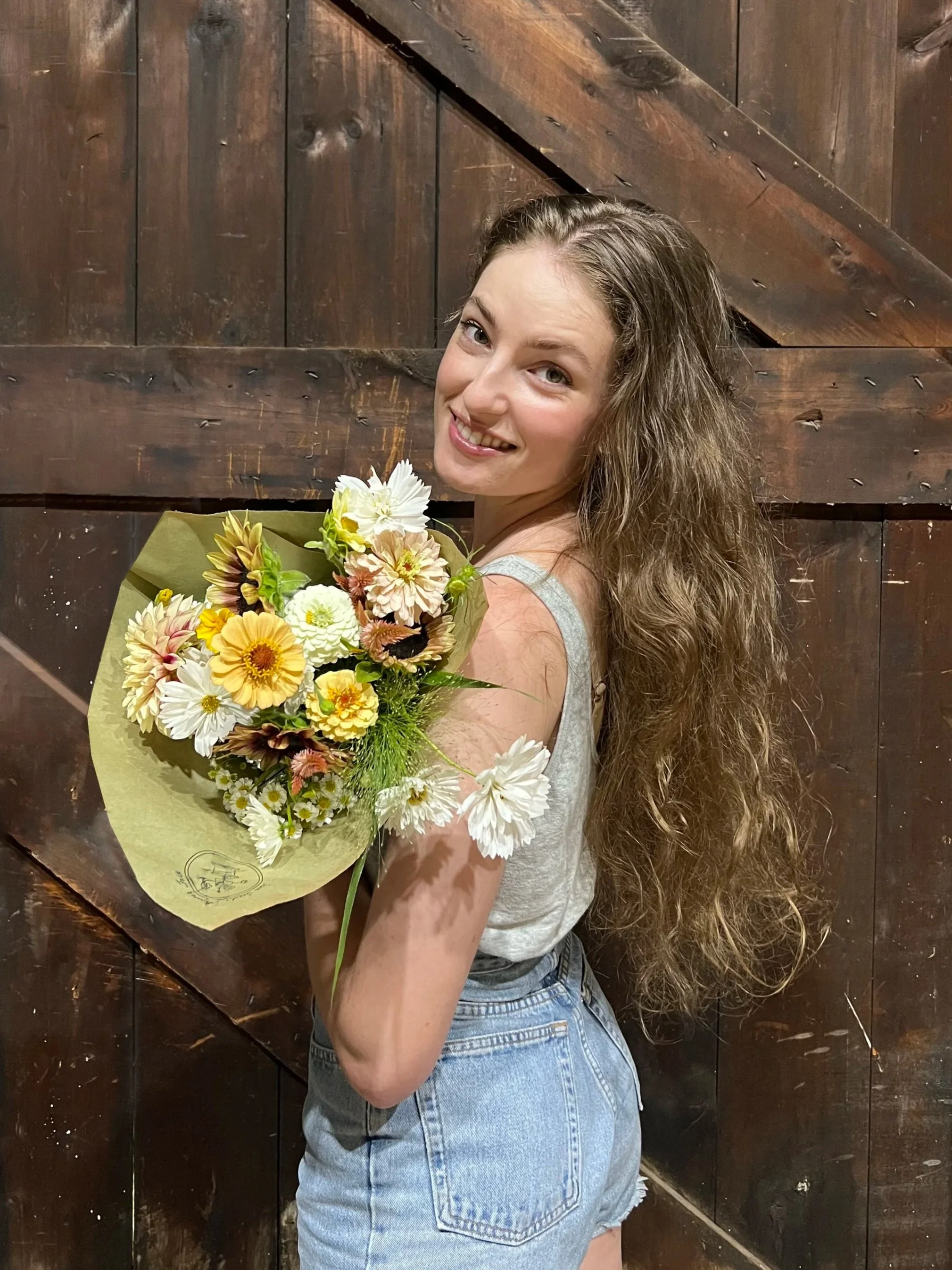
I’m a Mountainville native, a flower farmer and a florist. I love wearing ballgowns in fields, sewing pretty things, and rolling up my sleeves to work in the flower field.
Toya the Florist
Like many others, I came to floristry on an indirect path. I’d studied costume design in school and had been working on TV shows and films in NYC in costumes for years when the pandemic brought me back home upstate.
The things that had drawn me to costumes also drew me to flowers- an appreciation of color, texture and form and how they interact to create harmony. I’m interested in how flowers can tell stories that are nuanced and personal, without actual voices of their own. I’ve seen firsthand that what makes incredible designs possible on screen or in flowers is a combination of organization, anticipation, and creative vision, and would love to share that vision with you.
Toya the Farmer
After a few years in Brooklyn I still felt like a transplant. I missed the wild flowered roadsides of my youth and time in the garden. I moved back to my hometown to put down roots closer to my family, and when my mother’s garden was opened to me an absolute mania for flowers took hold.
I planted and grew many of the flowers for my wedding, and with the help of a few cherished friends and family members, we did all the florals for the event. The farm now stands in the backyard where my wedding tent did and I cannot wait to share this season’s blooms with you!
Our hellebores were originally planted by my great grandmother, an avid gardener.
That’s nice, but what are you growing?!
I’m so glad you asked!
This year, we’ll be growing 12 varieties of sunflowers for a total of 1200 plants!
We’re growing a few varieties of dahlias this year, and are excited to share tulips, iris, and specialty narcissus all spring.
It’s going to be zinnia madness, with 15 varieties growing. There will be a mix of giant blooms and sweet little minis in the most spectacular shades of coral, pink, peach, and deep wine.
We’re growing a few different kinds of marigolds, cosmos, poppies, amaranth, celosia, rudbeckia and sweet peas. Lots of herbs like mint, basil and bouquet dill will add fragrance to our bouquets, and we’re excited about growing matricaria; it’s a personal favorite for it’s simple good cheer.
Sustainability Statement - Farm
Sustainability means different things to different people, so we’d like to clarify what it means to us on the farm.
We grow using organic methods (although we are not organic certified) and do not use any pesticides. We limit our fertilizer use to a seaweed and fish emulsion applied a few times throughout our growing season and a heavy dose of compost and manure. We adopt limited tilling practices to protect soil structure and our worm friends, and work with very few mechanized tools to limit use of gasoline. Our most reached for tool is the wheelbarrow and a shovel.
In periods of intense pest pressure we do remove Japanese beetles, which are invasive in our region with a solution of dish soap and water.
We try to use limited plastics wherever possible, blocking weeds with cardboard instead of plastic weed barriers and choosing craft paper packaging with ink stamps for biodegradability. The tradeoff here is more human labor.
Growing this way is all around a lot more work than “traditional” fertilizer heavy, high till operations. The way we grow is kind to our planet and kind to our customers, and we hope that kindness translates when you see our work.
Sustainability Statement - Floristry
Sustainability is a touchy subject in floristry. There are a lot of different ideas about what is and is not “sustainable”, and so I’d like to outline our approach here in the name of transparency.
The farm team is just Toya, all of the flowers are grown and harvested by one person (me!). I grow as much as I can for our bouquets, weddings and events to offset use of non-local materials. When we need more flowers than I can grow, my first choice is to look to local farms. If this is not a possibility, I do use traditional sourcing methods. The majority of flowers that are sold to the trade are flown in from other countries, using lots of natural resources and less organic farming methods. While not ideal, this allows me to create events larger than I’m able to grow to exclusively.
As an individual farmer and designer, I myself am a limited resource. With that in mind, my goal is to work sustainably for myself and my farm.
I aim to grow a minimum of 65% of the flowers for each event, with the ideal goal being 100%. This limits our carbon footprint and lends a hyper seasonal and local look to our arrangements that I feel is compelling. It also allows me the flexibility to take on work that is inspiring and use materials that I can’t grow in our climate as needed. If I lock in on growing 100% of everything for every event, I won’t be able to sustain my own creativity or design as many wonderful events. Therefore, I feel that every locally grown stem counts towards a more sustainable final product, and that while I may not grow every stem I use in event work, raising awareness of local blooms and limiting our carbon footprint are worthwhile goals. Additionally our farm continues to grow, and that number may increase with time.
Floral Foam:
We are a foam free studio. Floral foam is an industry norm, but it breaks down into microplastics and is really bad for our environment. We understand why it’s used, but we elect to use reusable mechanics like chicken wire and sustainable foam alternatives. These require more labor, time and cost more than foam, but we feel this is a vital place to champion planet safe alternatives.